Choosing between selling 3D-printing digital products and publishing books through Amazon KDP can be difficult, especially if you’re starting an online business with a limited budget.
Both business models allow creators to sell products online without maintaining traditional physical inventory. However, the way products are created, marketed, delivered, and monetized is quite different.
With 3D-printing digital products, you can create downloadable STL files that customers use to produce physical objects with their own 3D printers. With Amazon Kindle Direct Publishing (KDP), you can publish eBooks and printed books and earn royalties whenever customers purchase them.
But which opportunity offers a better starting point for beginners? Is creating 3D models easier than publishing books? Which business has better long-term potential? And can AI tools make either process more accessible?
In this guide, we’ll compare both business models across startup costs, skills, product creation, competition, revenue potential, and scalability. We’ll also explore how 3D Ninja fits into the 3D-printing business model and whether it deserves consideration as a tool for beginners.
Affiliate disclosure: This article contains an affiliate link. If you purchase through that link, we may earn a commission at no additional cost to you. Our discussion of 3D Ninja is based on available vendor information, not personal testing.
What Is the 3D Printing Digital Products Business Model?
Selling 3D-printing digital products means creating downloadable design files that customers can purchase and use with compatible 3D printers.
The most common format is STL, although other formats may be used depending on the design and printing workflow.
For example, imagine creating a decorative plant pot, a desk organizer, a miniature character, or a replacement accessory. Instead of manufacturing and shipping these products yourself, you sell the digital design file.
After purchasing it, the customer downloads the file, imports it into compatible slicing software, and prepares it for printing.
Examples of 3D-Printing Digital Products
Some product categories worth exploring include:
- Home and office accessories: Desk organizers, cable holders, storage containers, and decorative accessories.
- Toys and collectibles: Miniature figures, articulated toys, puzzles, and fidget designs.
- Hobby and DIY products: Model accessories, mechanical components, and crafting tools.
- Garden accessories: Plant pots, seed organizers, labels, and gardening tools.
- Personalized designs: Custom nameplates, gifts, decorative objects, and accessories.
One important advantage is that a single original design can potentially be sold repeatedly without manufacturing a new physical product for every order.
Where Can You Sell 3D-Printing Files?
Several online marketplaces support digital designs and 3D models:
- Etsy: Allows sellers to offer original digital downloads.
- Cults3D: Focuses on downloadable 3D-printing designs.
- MyMiniFactory: Provides a marketplace for printable models.
- CGTrader: Offers 3D models for different applications, including printing.
However, marketplace requirements matter. For example, Etsy requires digital products to be made or designed by the seller. Downloading someone else’s model and simply reselling it is not an acceptable shortcut.
What Is Amazon KDP and How Does It Work?
Amazon Kindle Direct Publishing is a self-publishing platform that allows authors and creators to publish eBooks, paperbacks, and hardcover books.
Instead of approaching a traditional publishing company, you can prepare your manuscript, design a cover, upload your files, set your price, and publish through KDP.
How KDP Generates Revenue
KDP offers two main publishing formats.
1. Kindle eBooks
Customers purchase digital books and read them on compatible Kindle devices or applications. Depending on eligibility and pricing requirements, publishers can choose a 35% or 70% royalty option.
The 70% option is subject to territorial eligibility and delivery-cost deductions.
2. Paperback and hardcover books
Amazon prints books when customers order them. This print-on-demand model means you don’t need to purchase large quantities of books or maintain inventory.
Your royalty is calculated after applicable printing costs and other relevant deductions.
What Types of Books Can You Publish?
Popular publishing categories include:
- Educational guides and how-to books.
- Cookbooks and recipe collections.
- Fiction and short stories.
- Children’s books.
- Business and personal development books.
- Workbooks and activity books.
KDP can be attractive to people who enjoy writing, researching, teaching, or organizing information into useful publications.
However, publishing a book is not simply a matter of uploading a manuscript. Quality, editing, formatting, cover design, reader satisfaction, and market research all influence its commercial potential.
3D Printing Digital Products vs Amazon KDP: Key Differences
Although both models allow you to sell digital products, they serve different customer needs.
| Factor | 3D Printing Digital Products | Amazon KDP |
|---|---|---|
| Main product | STL and 3D design files | eBooks and printed books |
| Target customers | Makers and 3D-printing enthusiasts | Readers and learners |
| Required skills | 3D modeling and design | Writing and publishing |
| Delivery | Digital download | Digital or print-on-demand |
| Inventory | Not required for digital files | Not required for print-on-demand |
| Main platforms | Etsy, Cults3D, MyMiniFactory | Amazon KDP |
| Revenue model | Product sales | Book royalties |
| Quality control | Geometry and printability | Content and publishing quality |
| Main challenge | Technical quality and discoverability | Competition and discoverability |
Neither model is automatically easier. The better choice depends on your skills, interests, and ability to create products people actually want.
Startup Costs: Which Business Model Requires Less Money?
Startup costs can influence your decision, particularly if you want to test an online business without making a large investment.
Starting a 3D Printing Digital Product Business
You do not necessarily need to own a 3D printer to sell downloadable models.
You need access to suitable design tools, a way to validate your models, and a marketplace or storefront where customers can purchase your files.
Potential expenses include:
- 3D modeling software.
- AI-assisted design tools.
- Marketplace listing and transaction fees.
- Test printing or outsourced printing.
- Marketing and promotional expenses.
A physical 3D printer is optional for a digital-file seller, but testing is valuable because a model that looks attractive on screen may not print correctly.
Starting an Amazon KDP Business
KDP allows you to publish without purchasing book inventory upfront.
Your potential expenses include:
- Writing and editing.
- Book cover design.
- Interior formatting.
- Research and content development.
- Marketing and advertising.
You can handle several of these tasks yourself, but professional editing and design may increase your initial investment.
Verdict: Both models can be started with relatively limited upfront spending. KDP has an established publishing and print-on-demand infrastructure, while 3D-file selling can have low production costs once you have the skills and tools to create reliable designs.
Product Creation: Which Is Easier for Beginners?
This is where the two business models become particularly different.
Creating 3D Models and STL Files
Creating a useful 3D model requires more than producing an attractive visual.
The design must have suitable dimensions, appropriate geometry, and enough structural integrity to work with the intended printing process.
Beginners may need to learn:
- Basic 3D modeling.
- Dimensions and measurements.
- Geometry and mesh repair.
- Slicing and print preparation.
- File export and compatibility.
AI tools may reduce some of the design workload, but they do not eliminate the need for quality checks.
Writing and Publishing Books Through KDP
KDP has a different learning curve.
You need to understand your target readers, research useful topics, create original content, edit the manuscript, and prepare a professional cover and interior layout.
AI can help with research organization, brainstorming, editing, and content development. However, low-quality or repetitive books are unlikely to provide a satisfying reader experience.
Amazon also requires publishers to disclose AI-generated text, images, and translations. AI-assisted content, such as author-created material refined with AI, does not require the same disclosure.
Verdict: If you enjoy writing, KDP may feel more natural. If you enjoy designing objects and exploring 3D technology, the 3D-printing business may be a better fit.
Profit Potential: Which Model Offers Better Economics?
Both models have the potential to generate recurring sales from products created in advance. However, revenue and profit are not the same thing.
How Sellers Earn From 3D Printing Digital Files
Suppose you sell an original STL design for $5.
If you sell 100 copies, your gross revenue is $500.
That does not mean you earn $500 in profit. You still need to account for marketplace fees, payment processing, software expenses, advertising, refunds, and other business costs.
The attractive part is that digital delivery does not require you to manufacture and ship a separate physical item for each customer.
Understanding Amazon KDP Royalties
Consider a hypothetical eBook priced at $4.99.
If the sale qualifies for the 70% royalty option, the basic royalty calculation starts at approximately $3.49 before applicable delivery costs and other adjustments.
For a paperback, the calculation is different.
For example, Amazon’s official KDP documentation gives a 300-page black-ink paperback sold in the United States at $9.99 with a $4.60 printing cost and a 60% royalty rate. The resulting royalty is $1.39.
This illustrates why paperback pricing and production costs deserve careful consideration.
Why Sales Revenue Is Not the Same as Profit
A successful business needs to account for:
- Product development time.
- Marketplace and transaction fees.
- Software subscriptions.
- Advertising costs.
- Refunds and customer support.
- Taxes and other operating expenses.
Neither business model guarantees a particular income. Your results depend on product quality, customer demand, pricing, competition, and marketing.
Competition and Market Demand: Which Has More Opportunity?
Both markets offer opportunities, but neither is free from competition.
Competition in the 3D Printing Marketplace
The 3D-printing market is expanding, but more sellers are entering it.
CGTrader’s 2026 marketplace report, based on June 2025 to May 2026 data, reported that printable-model demand increased 7.5% year over year while supply increased 23.4%.
This suggests that simply uploading more files may not be enough to attract buyers.
Quality, originality, technical reliability, and niche selection matter.
Competition in the Amazon KDP Marketplace
KDP also has a large publishing ecosystem.
Popular subjects can attract substantial competition, particularly in broad categories such as self-help, fitness, business, and low-content publishing.
The challenge is not simply publishing more books. You need to create something that satisfies a particular audience better than competing titles.
A well-researched niche, useful information, professional formatting, and a compelling book cover can help differentiate your publication.
Verdict: Both markets reward differentiation. 3D printing offers opportunities in specialized product categories, while KDP offers opportunities for creators who can develop useful, original publications.
Can You Start Without a 3D Printer or Publishing Experience?
Yes, but you should understand the difference between not needing equipment and not needing expertise.
A digital 3D-file seller can operate without owning a printer. However, they still need to understand how printable designs work and how to verify file quality.
Similarly, you do not need professional publishing experience to start KDP. But you should learn manuscript preparation, copyright requirements, formatting, and book marketing.
In both cases, outsourcing or AI assistance can help with selected tasks. Neither removes the responsibility to deliver a product that meets customer expectations.
How 3D Ninja Can Help Beginners Explore the 3D Printing Business
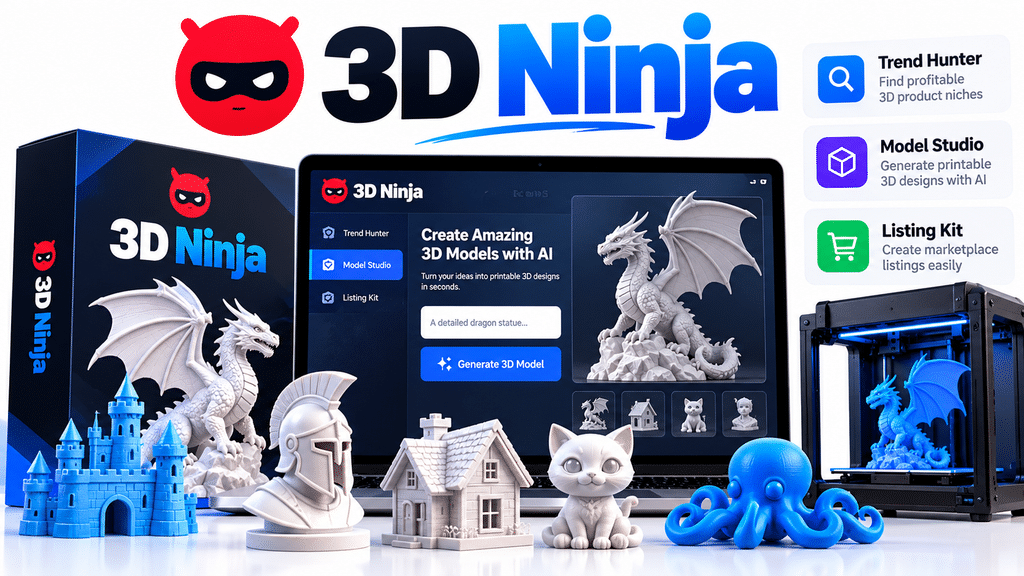
If you’re interested in selling 3D-printing digital products but lack advanced modeling skills, 3D Ninja is one tool worth investigating.
The product is promoted by Dave Espino and Shane Nathan through WarriorPlus.
According to the vendor’s affiliate information, the software is organized around three main features.
1. Trend Hunter
The vendor describes Trend Hunter as a tool for researching potential 3D-printing niches and identifying product opportunities.
This could help beginners organize their product research before deciding what to create.
However, suggested trends should be validated against actual marketplace listings and buyer demand.
2. Model Studio
Model Studio is promoted as the feature for generating downloadable STL files.
The idea is to make 3D model creation more accessible to people who may not have advanced modeling experience.
Generated models should still be inspected and tested before being offered for sale.
3. Listing Kit
Listing Kit is designed to assist with preparing marketplace listings.
This is useful because creating a model is only part of the process. Sellers also need appropriate titles, descriptions, keywords, and product presentation.
Pricing and Offer Information
According to the vendor’s JV page, the front-end offer is $27 for one year of 3D Ninja Basic.
The advertised funnel also includes additional offers:
- Front end: $27.
- Niche Pack: $27.
- Agency Reseller License: $97.
- Founder Lifetime Deal: $298.
The vendor advertises a 30-day money-back guarantee and 50% affiliate commissions across the funnel.
These are vendor-published offer details and may change. Check the current sales page for the actual checkout price, included features, licensing terms, and refund conditions.
Interested in exploring the software?
Who Should Consider 3D Ninja?
It may be worth investigating if:
- You want to explore downloadable 3D-printing products.
- You are interested in AI-assisted 3D design.
- You want to research product niches.
- You need help preparing marketplace listings.
- You are willing to validate and improve generated designs.
It may not be the right choice if you expect software alone to create a profitable business without research, quality control, or marketing.
Which Business Model Is Better for Different Types of Beginners?
There is no universal winner. Your interests and strengths should guide your decision.
Choose 3D Printing Digital Products If…
- You enjoy technology, design, and creative projects.
- You want to explore selling downloadable STL files.
- You are interested in specialized hobby and functional products.
- You are willing to learn about 3D model quality and printability.
- You prefer creating visual and functional products rather than writing books.
Choose Amazon KDP If…
- You enjoy writing, researching, and teaching.
- You can identify useful topics for specific readers.
- You want to create eBooks or print-on-demand books.
- You understand content development and publishing.
- You prefer working with written information rather than 3D design.
Consider Both Business Models If…
You have the time and resources to develop two separate product lines.
For example, someone with an interest in gardening could publish a gardening guide through KDP and separately create original printable garden accessories.
However, running two businesses simultaneously can divide your attention. Beginners may achieve better results by learning one business model, validating its potential, and expanding later.
Final Verdict: 3D Printing Digital Products vs Amazon KDP
So, which business model is better in 2026?
3D printing digital products may be the better choice for creative people interested in technology, 3D design, and downloadable products. It offers the possibility of selling original designs repeatedly without handling physical inventory or shipping.
Amazon KDP may be the better choice for writers, educators, researchers, and people who enjoy creating books. Its print-on-demand infrastructure and established publishing ecosystem make it accessible to creators who want to reach readers without managing book inventory.
Neither business guarantees passive income or quick profits. Both require market research, original products, quality control, and effective marketing.
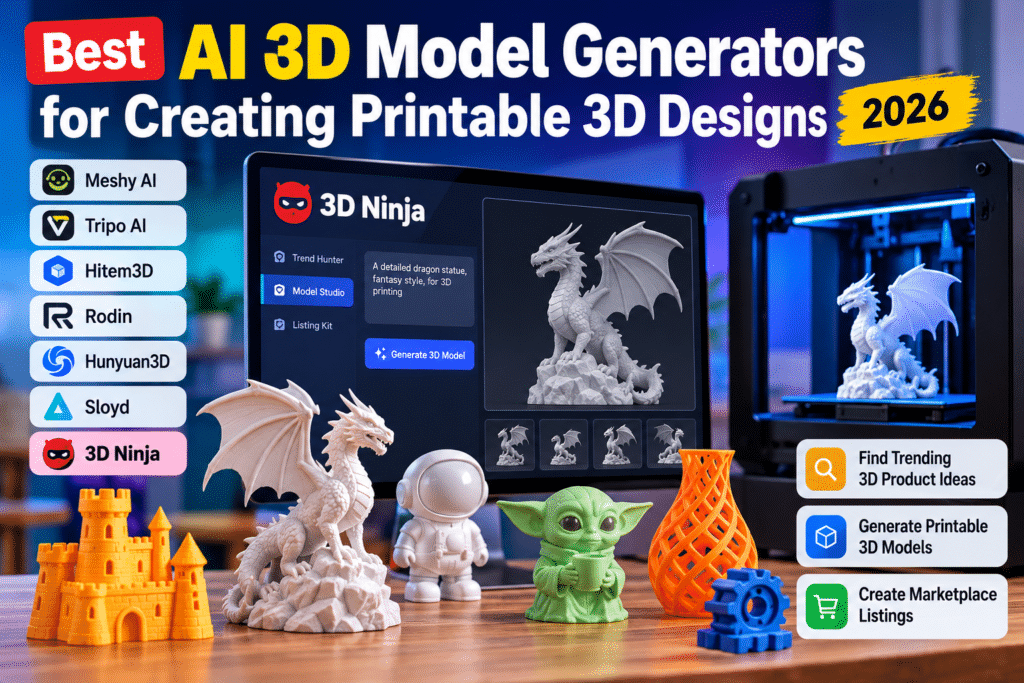
If you are particularly interested in exploring the 3D-printing opportunity, 3D Ninja is worth investigating as one possible tool. Just remember that software can support product creation, but it cannot replace good product ideas, technical validation, and a sound business strategy.
The best business model is ultimately the one you can understand, execute consistently, and improve over time.